


Albania, one of my absolute favorite countries. We are currently in Albania, for the third time. Our first trip was in 2018, then we returned just in time to ride out martial law lockdown in 2020. I finished my book during that stint. Then we returned again this past summer. This time we are in the north of the country and learning Gheg Albanian. Although a small country, there are different dialects, as well as different types of music isolated to each region and their history.
This is a country with a rich and complicated history. One thing that has always remained is their identity as Albanians and their folk traditions have lasted through centuries of varying empires ruling these lands, including one of the strictest dictatorships of the last century.
What I love about this country (there are many things, really), is that they deeply know who they are and they have always been welcoming to the stranger. They have provided shelter for the Jews who were running from Hitler. They continue to provide opportunities for anyone willing to make an effort to become part of their community. I feel so welcome here, and I love the food. I’ve been adopted by so many shopkeepers who don’t even know my name. We are treated as family now. Although my personal heritage is German American, a part of me is really starting to feel Albanian, if I even dare say such a thing. Not sure I’m worthy yet. I’m still learning. To the Albanians: Faleminderit Shqipëri që mirëprite familjen time.
To start things off, please enjoy this delightful traditional performance that gives you a taste of what is to come.
Albanian Opera Singer Meets Hollywood
Before we go into the history and the complexity of their UNESCO heritage music and modern convergence of folk and techno, among others, I think it is also important to mention that the famous Diva song from the 1997 film “The Fifth Element” was sung by Albanian opera singer, Inva Mula. The real name of the song is “Il Dolce Suono” from the opera Lucia di Lammermoor by Donizetti. In the opera, this scene is where Lucia falls into madness. It is her wedding night. Although the festivities carry on in the Great Hall, she stabs her new husband (Arturo) in their bridal chamber. Unaware of what she has done, she roams the crowd in the Great Hall reminiscing of her beloved Edgardo, imagining herself married to him. In the film, “The Fifth Element,” the name Edgardo is changed to Esther.
As with many of the world-class musicians I’ve found here in Albania, Inva is definitely among them. Take a listen.
Albanian History
Albanian history is ancient, and as such their roots aren’t entirely clear. However, archeological and anthropological studies have collected data that lead many researchers to believe that the Albanians are the direct descendants of the ancient Illyrian tribes. Linguistically, their language is the most unique of the Indo-European languages.
The Illyrians date back to the stone age and their historic presence in what is now known as Albania dates back to the Bronze Age. So, this is a very ancient culture. In fact, the town I’m in now, Shkodër, is over 4,000 years old and it dates back to the Bronze Age. Founded by the Illyrian tribe of Labeatae in the 4th century BCE, it is the oldest city in Albania and has been continuously inhabited the entire time.
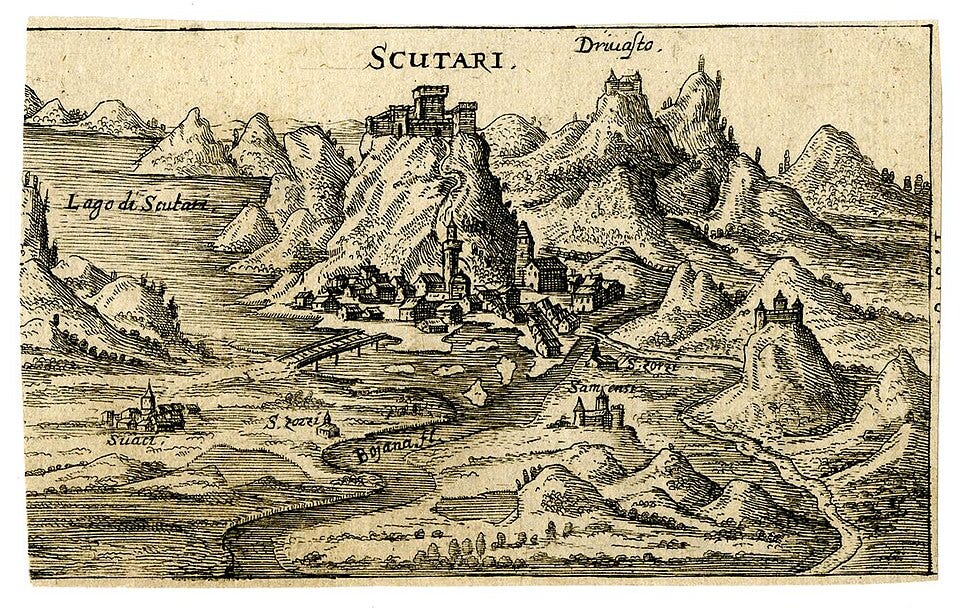
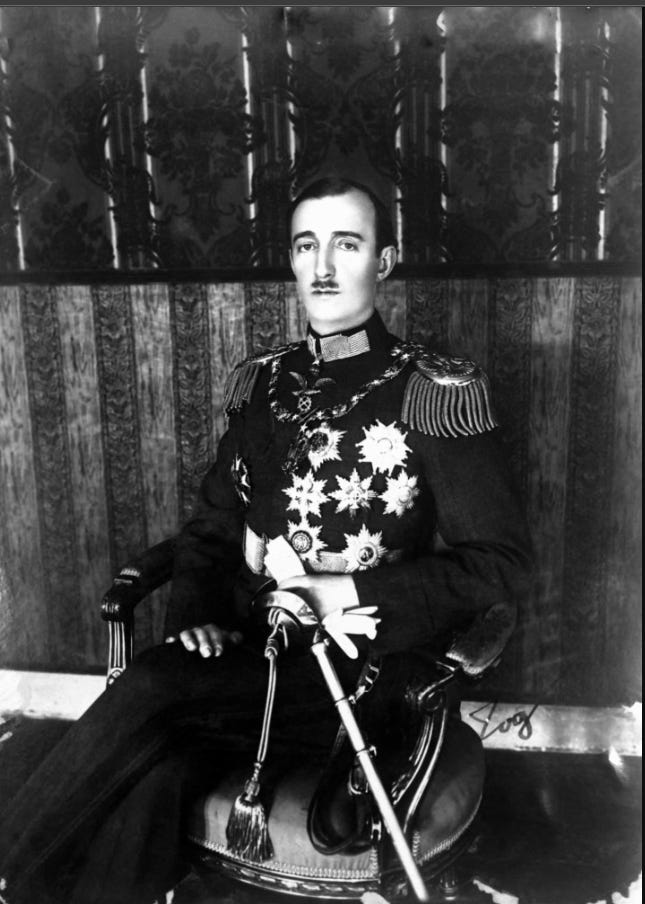
There are ancient castles and ruins throughout these lands, including those of the Roman Empire, the Byzantine Empire, and the architecture from the Ottoman Empire. After 500 years of Ottoman rule, they finally gained their independence as their own nation in 1912. They even had a king, King Zog. He was Albania’s only king (although there were Illyrian kings centuries before) and he ruled from 1922-1939. Born in 1895, he became the country’s Prime Minister at the age of 27, later becoming the country’s President. Eventually, they declared him, King. In 1939, Mussolini declared Albania an Italian Protectorate under King Victor Emmanuel III. As a result, Zog was forced to flee and spend the rest of his life in exile.
On November 29, 1944, Albania was liberated from Italian protectorate statehood by the National Liberation Movement. The Anti-Fascist National Liberation Council became the provisional government of the country. This party was heavily dominated by the two-year-old Communist Party of Albania. Enver Hoxha, the party’s first secretary, eventually became the country’s Prime Minister. This government was an openly Communist party, which was a common theme among the European Eastern Bloc at the time. As history has shown, these Communist parties began as part of a coalition government for a few years before they eventually took complete control and created one-party states. Albania’s one-party state was the most extreme. Many liken it to having been the North Korea of Europe, for modern day reference.
It is worth noting that before the Communist Party seized full control over the country, there was an additional party that was very nationalist, called the Balli Kombëtar. The nationalist party was sidelined and eventually became a Nazi-Germany established puppet-government, which was part of the German occupation of Albania. They fought against communist groups in Albania.
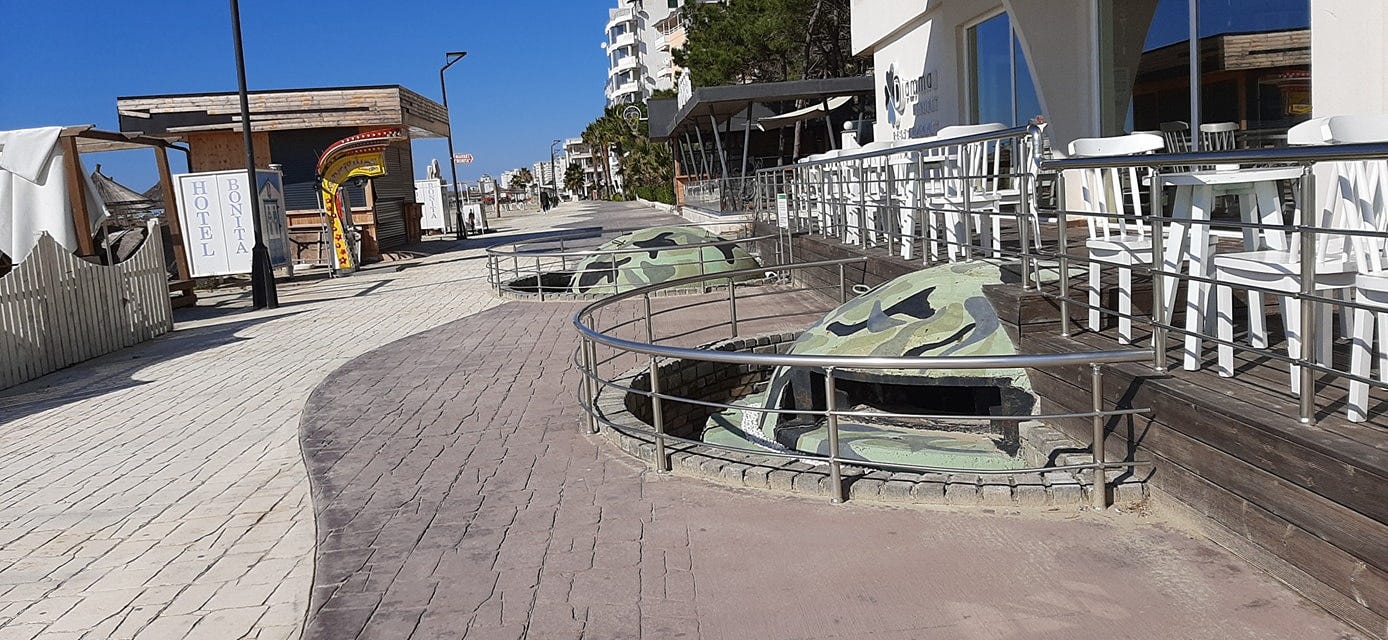
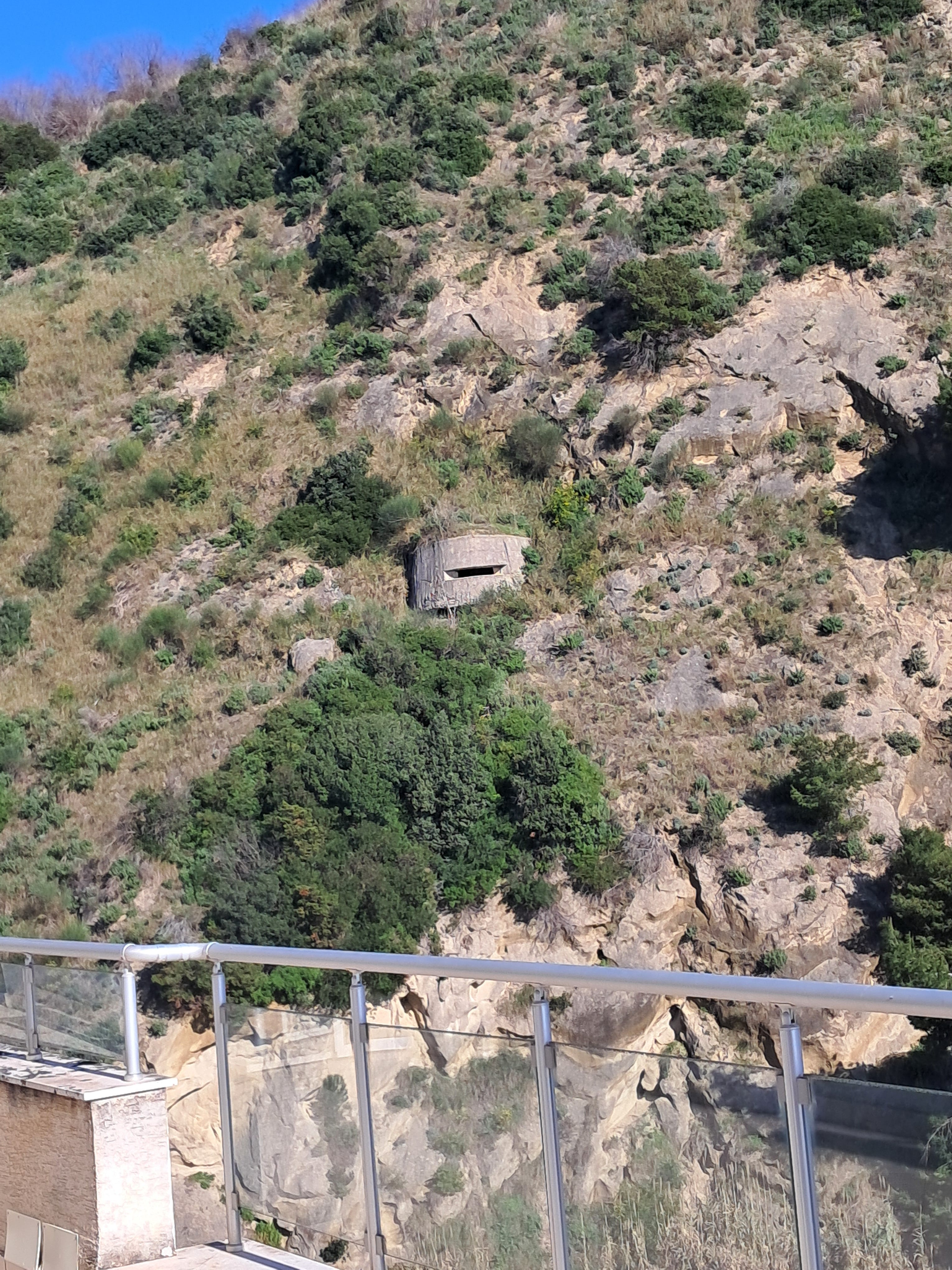
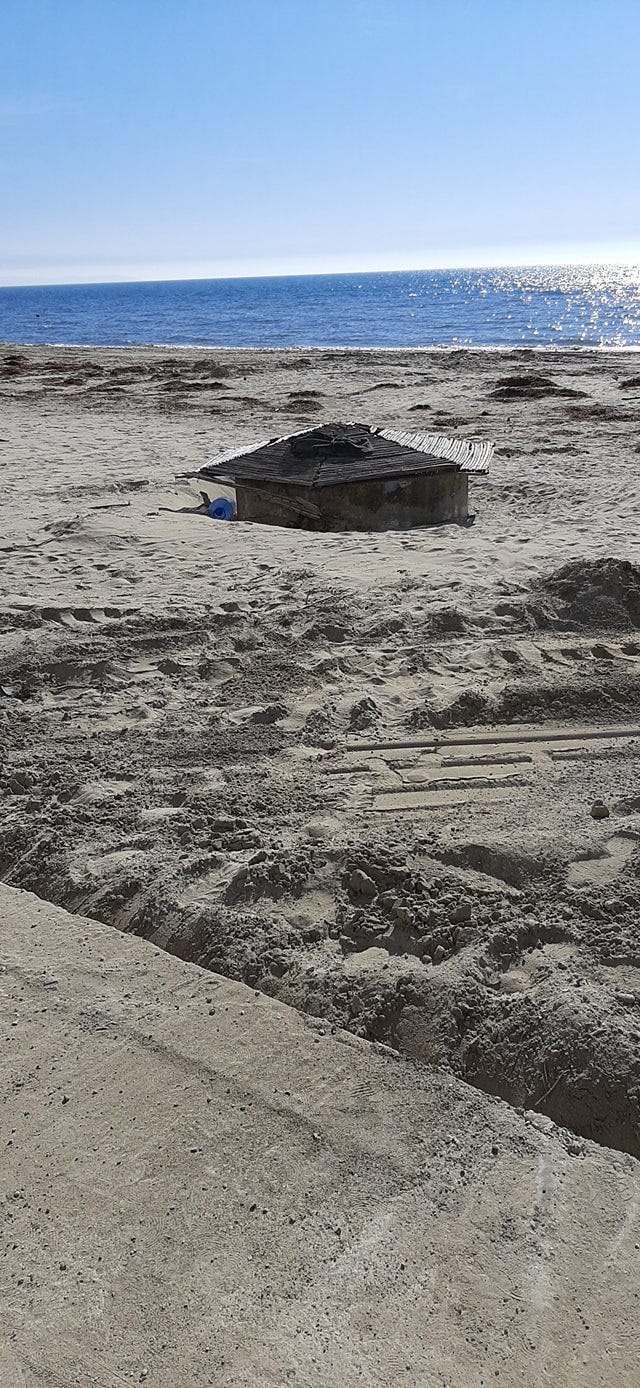
Let me just say this, the communists and the fascists were not the same groups. They fought against one-another and the communist party won. They were all Albanian. They are all devoted to their country. They are all devoted to their culture. However, there was influence surrounding them by many fascists throughout Europe as well as other communist movements in their neighboring countries. The most fascinating thing for me was that their leader, Enver Hoxha, was so similar to many extreme leaders in that he was convinced that they were going to be invaded by some kind of enemy. As a result, he had more than 750,000 bunkers built in random places all over the entire nation for the citizens to seek refuge should an invasion occur. These bunkers are randomly found in places like the mountains, the beach, and just some random spot in a field or in the middle of a city. You’re just walking around and, “Hey look! It’s another bunker!”
These two were found along a sidewalk partway under the patio of a restaurant in Durrës, next to the beach. Clearly someone thought painting them would make them more interesting. I took this photo in June 2020.
This one was in a cliff along one of the highways and another on the beach.
Albanians were not allowed to leave the country during Hoxha’s reign. They were completely isolated from the rest of the world. As a result, their culture was reinforced and remained untouched. Additionally, cars were banned in the country. Most people walked or used bicycles. This may also play a role as to why the regions are so diverse and traditions so unique in each region. Below is a video showing some their traditional music and dance during the dictatorship in 1984. To this day, you will still see performances like this in Albania. In fact, when I see this video, it trips me out a bit because I’ve been to that National Museum behind them in one of the scenes and it looks the same today. Identical, actually. the only thing that has changed is that the area around it, called Skanderbeg Square, has grown and there are more buildings now. The painting on the top of the museum is exactly the same in 2025. The same can be said about Kruja Castle in the other scene.
Iso-Polyphony
Iso-polyphony is a UNESCO sanctioned musical heritage unique to Albania. I will admit, there will be many videos relating to this topic alone simply because each region has their own style. The video below gives you a small sampling and a smidge of the history and the different styles.
What is iso-polyphony? It’s a traditional multipart singing style that includes two separate melodic lines sung simultaneously and frequently paired with a drone part that is either percussive in nature or continuous. This distinct combination of voices lends to a very powerfully unique harmonic sound. The songs convey the history of the people, emotions, and their cultural identity. Passed on for generations, it was declared by UNESCO as an Intangible Cultural Heritage of Humanity in 2005.
This recording is one of my favorite samples. I really recommend listening with headphones in order to deeply feel the richness of the polyphonic sounds.
As mentioned in the first video from UNESCO, there is a distinct geographic separation in the types of music from the north and the south of Albania. I’m currently in the north, which is known as the Gheg region. The music in this region boasts of heroic epics and songs of bravery telling tales of Albanian invasions over the centuries. These rugged ballads are grand in nature when in comparison to the music of the south. In the south, you will find the Labs and Tosks, which have softer, more relaxed and gentle music.
There are influences from external sources, such as the Ottoman Turks in their music, as well as in their architecture and food. However, their folk music has managed to retain its own identity distinct from external influence, especially in the mountain villages, where you will find the oldest sounds and traditions.
The mountainous regions of Albania have very small villages where the locals are isolated from the rest of the country. Many of them have no roads to their homes. They walk through the mountainous terrain through the forest and call to their neighbors with unique sounds, as we see in the video below. As you can imagine, music in this region is very unique and offers them communion with one another. It’s connection and love. More importantly, this video also gives you a deep glimpse into the culture and the way they are unconcerned about religion when it comes to being in community. Albania is truly one of the most accepting countries I have ever encountered. You will see a mosque right next door to a Catholic church. You will see women in modern clothes, next to a nun in full regalia, and later a woman in a full burka. No one bothers anyone. All are respected.
This is a collage of three songs from the ancient Albanian tradition of the pre-Ottoman Turk rule. Lyrics in old Albanian Tosk dialect below:
Rina, Rina ti ku vajte luli o?
Luli-o lulëza ime, zëmra moj
Zëmëra më këndon.
Nëna ime vajti për ujë luli o
Luli-o lulëza ime, zëmra moj
Zëmëra më këndon.
E bija ime moj
Ja uji tek ku është.
E bija ime moj
Ja uji tek ku është.
Nëna ime m’u ça buza luli o
Luli-o lulëza ime, zëmra moj
Zëmëra më këndon.
Doli dielli dhe ma dogji luli o
Luli-o lulëza ime, zëmra moj
Zëmëra më këndon.
E bija ime moj
Ja dielli tek ku është
E bija ime moj
Ja dielli tek ku është
Dhe zemra më këndon.
Translation: Rina, Rina, where did you go, flower? Flower-o my flower, my heart My heart sings to me. My mother went for water Flower-o my flower, my heart My heart sings to me. My daughter, where is the water? My daughter, where is the water? My mother, my lip split Flower-o my flower, my heart My heart sings to me. The sun came out and burned my flower-o Flower-o my flower, my heart My heart sings to me. My daughter, where is the sun? My daughter, where is the sun? And my heart sings to me.
I realize that this article is long, so I will leave you with the following 47 minute documentary on the depth of the iso-polyphony and monophony unique to this country. I personally can never get enough of this culture and their traditions. It really warms my heart, and I love the people of Albania so much.
Modern meets tradition
Albanians really do perform their traditional songs and dances all the time throughout this country. Every single national holiday, celebration, wedding, funeral, or any other excuse to get together, they are performing these songs. They are also making music videos and have many performances on their local tv stations and theaters. The video below is one example of taking the tradition into the modern music video. After this video, I will then dive into modern popular culture and the ways in which they have expanded since opening up to the world and how uniquely they blend modern with tradition.
Shkodra Electronike
2025’s Eurovision entrant from Albania was Shkodra Electronike. This unique group blends techno with iso-polyphonic singing. I have fallen in love with this group and listen to them regularly. Their music is so unique and definitely motivating. I truly respect the vocals and unique style that they bring.
Eugent Bushpepa
Eugent is an example of how Albanians are catching up from the music they were denied during the dictatorship. He is a rock singer and, one of the best I’ve ever heard. We were in Albania in 2018 when I first found out about Eurovision (I know, I was late to the party). More importantly, it was the year that Eugent Bushpepa performed for Albania. To this day, I will never forgive Eurovision for not giving him the trophy. He is phenomenal. Such a spectacular musician. My guess is that Eurovision spectators couldn’t understand the language, which is a tragedy. People shouldn’t be forced to sing the same language to compete. He does sing songs in English, but this one is stunning in his native language, Shqip.
A full performance set just in case you need more. I always need more of Eugent’s singing. He is right up there with the best of the 80’s rockers as far as I’m concerned. In fact, if you look him up on YouTube, you will find many recordings of him singing songs from America’s best, including She’s Gone by Steelheart, Thunderstruck by AC/DC and A Whole Lot of Love by Led Zepplin.
Elvana Gjata
Elvana is Albania’s princess, or at least that’s how I’ve seen her referred to in various places. I first discovered her the same year I discovered Eugent. The song that got my attention (and I still adore) is Me Fal, which I highly recommend you take a moment to hear. You won’t regret it. It’s very beautiful. However, we are here today to discuss the merging of tradition and modern, and this song below is exactly that.
Additionally, Kuz e zi je ti is another song of hers that Albanians as a whole have adopted as their national song when it comes to celebrating anything they are proud of, especially their futbol wins. You have to admit, it’s quite compelling. She also merged folk and modern in this epic song.
Alis
One of the things that I love about music in Albania is that it often sings about the things that are most important in life: family, community, love, and valuing life. The song below is the entry for Albania’s 2026 Eurovision entrant, Alis. Alis is a popular singer that I’ve recently discovered. This song is about a mother missing her son and waiting for his return.
Among important songs, there is a legend of a walled in woman who was immured in Rozafa Castle here in Shkodra. You can learn more about the legend here, as it is a common storyline found throughout the Balkans in different structures. Immurement in the Balkans is widespread and a curious history that has spurned legends throughout these lands. In fact, the song below was about that immured woman in Rozafa Castle.
I could honestly keep going with the massive numbers of incredible artists that this country boasts, many of them hail from the city I am in now. In fact, their 2026 Eurovision entrant is also from here. Not only is it the oldest city in the country, it’s also the arts and culture capital of the country. I rather do like it here. Want to take a look at the city? This video gives you a nice, picturesque view of my current daily views.
Faleminderit dhe mirupafshim!!